CN

×

keywords:

xxxx1 xxx2 xxx3 xx4 copy
Shenzhen Meiyad Optoelectronics Co., Ltd. Shenzhen Meiyad Optoelectronics Co., Ltd.

News

Meiyad: Strive to Be the Leader of Creative LED Display

25
05
2021

Q: In this ISLE 2021 exhibition, what products did Meiyad bring, and what are the highlights?


A: Meiyad's products are very diversified. This time we brought a variety of special-shaped creative led displays, including film transparent led screens. Our p6 film transparent led screen adopts led lamp bead bare crystal ball planting technology, and the light board adopts transparent crystal film, with a transmission rate of up to 95%, which can transform glass into an advertising medium without affecting lighting or aesthetics. It's widely used in glass curtain wall, interior decoration and other fields. Meiyad has been very successful in building products in this area.


Meiyad P6 film transparent LED screen


Another key product is the p4 outdoor flexible led screen, with IP68 whaterproof. It has very strong flexibility, and the maximum bending arc is greater than 120 degrees. Users can customize different shapes according to their needs, which perfectly fits the outdoor advertising scene. At present, we adopt environmentally friendly water-based paints developed by special materials and GOB molds for two different production processes, which can meet the actual needs of different customers.


Meiyad P4 outdoor flexible LED screen


Our core product, the fine pitch led display, has the advantages of ultra-light and ultra-thin, high precision, fast heat dissipation, beautiful appearance, and convenient installation. 16bit broadcast-level high grayscale, 6000:1 high contrast, 3840Hz high refresh rate, seamless splicing, delicate pictures, and colorful colors.


Meiyad fine pitch LED screen


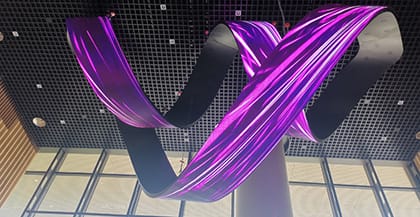
In addition, the logo art led screen, the circle led screen and the cube led screen are all very eye-catching exhibits.


Meiyad creative LED screens


Meiyad round cicle led screen


Q: What is the overall product line layout of Meiyad? Which area is the strongest at present, and which areas will continue to be strengthened?


A: As mentioned earlier, our product line is very diversified, including creative led displays, small pixel pitch, indoor and outdoor fixed led displays, transparent led screens, rental led screens, and it also includes the smallest pixel pitch in the industry P2.6 floor tile led screen. It's mainly determined by customer needs. In today's led display era, the phenomenon of product homogeneity is serious, single product layout is no longer popular, and the needs of the same customer are gradually becoming diversified. Meiyad's complete product range can provide customers with more abundant choices.


6.webp


All along, Meiyad's strengths and characteristics have been personalized customization. Since customization needs to adapt to different structures and different scenarios, Meiyad has higher requirements for technology to ensure that its products serve customers with the best quality. Next, Meiyad will focus on the development of outdoor flexible led screen. Prior to this, Meiyad took the lead in launching indoor flexible led modules and became the first manufacturer in the industry to successfully develop soft led modules with a single PCB. Now the development and design of outdoor soft modules is bound to be the first. We will make persistent efforts based on our successful experience and be the industry leader.


Q: There are many companies that make special-shaped led screens in the industry. What do you think of Meiyad’s core competitiveness compared to its peers?


A: Meiyad has established a sound R&D, production and sales system. Especially in the past two years, we have increased our investment in R&D, increased R&D funds, purchased advanced equipment, and expanded our talent team. At the same time, we have been understanding the trend of the market and the development of technology, combining with the changes in market demand to build our own system. We will continue to explore new areas, keep up with the new development of the product market, and accelerate product improvement and application.


Q: What are the business expectations of Meiyad in the first quarter? What is the next business plan?


A: The epidemic that began last year has affected Meiyad to a certain extent and disrupted our original plan. Although the first quarter was still affected by the aftermath of the epidemic, it has shown a recovery trend. The growth space and future capacity of the led display market are considerable, we remain optimistic about our business expectations this year.


In the future, Meiyad will adhere to the diversification of product categories, individualization of customer customization, and promote the overall optimization of technology, so as to make the greatest contribution to the development of the industry.


You May Also Like

Meiyad Continues to Shine on Day 2 of SEAMEX 2026 in Malaysia

22|05|2026

Meiyad Continues to Shine on Day 2 of SEAMEX 2026 in Malaysia

Today marks the second day of SEAMEX 2026 in Malaysia, and Meiyad continues to attract strong attention from visitors, partners, and industry professionals across Southeast Asia.At Booth A033, Meiyad is showcasing a wide range of innovative LED display solutions, including the high-end SK Rental LED Screen, COB LED displays, SMD LED displays, and GOB LED display technologies. These products demonstrate Meiyad’s professional capabilities in stage rental, commercial display, cultural tourism, and immersive audiovisual applications.Throughout the exhibition, Meiyad’s booth has welcomed many customers and industry partners who showed great interest in the outstanding visual performance, seamless display quality, and creative customization solutions of our LED displays. The event also provides an important platform for Meiyad to strengthen cooperation with Southeast Asian clients and further expand our presence in the regional market.As SEAMEX 2026 enters its final day tomorrow, Meiyad warmly welcomes more visitors to Booth A033 to explore our latest LED display technologies and discuss future cooperation opportunities.We sincerely appreciate the support and trust from all customers, partners, and visitors, and we look forward to creating more innovative audiovisual experiences together.Exhibition: SEAMEX 2026Booth: A033Location: Borneo Convention Centre Kuching, Malaysia

LED Display Screen Software Installation and Debugging Tutorial

20|05|2026

LED Display Screen Software Installation and Debugging Tutorial

Software Installation, Login & Screen ConfigurationDownload & InstallationOfficial website download:Visit NovaStar official website(www.novastar-led.cn or https://www.novastar.tech) → Support → Software Download, and download the latest version of NovaLCT (recommended v5.5.0 or above).Installation steps:I. Double-click the installation package.II. Use the default installation path.III. Complete installation.IIII. Disable antivirus software temporarily to avoid accidental blockingDevice ConnectionSynchronous System (Direct Network Cable Connection)Step 1: PC → Sending Card: Connect directly via USB cable; or Connect through the same LAN using network cable. (Default IP range: 192.168.0.xxx / 192.168.1.xxx)Step 2: Sending Card → Receiving Card: Cascade via network cables. Receiving card connects to the LED screen HUB board.Asynchronous System (WiFi Direct Connection)Step 1: Connect PC/mobile phone to the player box WiFi (Default SSID: AP + last 8 digits of SN, Password can be found on the device label); or connect through the same LAN.Step 2: Connect the player box to the HUB board (receiving card) and power on.Software LoginStep 1: Open NovaLCT,Click Login→Advanced Synchronous Login,Default password:666 or admin.Step 2: Successful connection message: "Control System 1, No Display Screen"; If connection fails, check wiring and check power supply.Smart ConfigurationStep 1: After login, enter Screen Configuration → Smart Settings.Step 2: Select Chip model, Decoding method, Module size (e.g. 172x86), click Next stepStep 3: Follow the screen instructions: Bright line direction→Color matching→Pixel-by-pixel calibration, generate configuration file (.scfg).Step 4: Click Send to apply parameters to the receiving card.Manual ConfigurationStep 1: Receiving Card Parameters: Enter Receiving Card → Port Configuration → Set width, height, number of data groups, and scan mode (e.g. 1/32 scan).Step 2: Sending Card Resolution: Enter Sending Card → Output Resolution → Enter actual screen resolution (e.g. 1920×1080) → Enable scaling → Click Send.Step 3: Load Configuration File: Supports local (.scfg/.zip) or cloud configuration files. Allows quick parameter reuse. [__LINK_ICON].Program Creation & Publishing (Asynchronous System)Pingjl Installation & OperationStep 1: Download Pingjl from the official website. Double-click the installation file and follow the Pingjl. After first launch, select "Asynchronous Playback" mode. Click "Start Now".Step 2: Open Pingjl and add devices: (Search LAN/WiFi devices, Default password: admin).Step 3: Create a new program: Program Management → New Program. Set resolution matching the screen.Step 4: Add media: Support Add media, Videos (MP4/AVI), Text, Clock, Weather forecast.Step 5: Edit attributes: Playback duration, Transition effects, Loop mode, Multi-layer overlay supported.Program PublishingStep 1: Select the program→Click Publish→Select target terminal→Confirm sending.Step 2: After successful publishing, the player box automatically loads and plays the program. If publishing fails, check network connection→Check device storage.Device Management, Maintenance & Firmware UpgradeFirmware UpgradeEnter Program Upgrade→Connect to the Internet, Select cloud upgrade, Choose corresponding sending card / receiving card firmware, Wait for completion, Do not power off during upgrade.Offline Upgrade:Import local firmware package (.bin), batch upgrade devices:Step 1: Login through "Login → Advanced Synchronous Login",enter password admin or 666. (For asynchronous products (JT/TB series), select Media Player Login)Step 2: Type "admin"or "666888" on the main interface.Step 3: Select communication port. If you need to reconnect the sending card, click "Reconnect".Step 4: Select the range to view, click "Refresh" to view the current software version of the hardware.Refresh All: View all sending/receiving card versions.Specified Refresh: View the software versions of the specified sending and receiving cards.PS: Simply click "Refresh All" on the screen to view the receriving card model and firmware version.Identifying Driver & Decoder Chips:Please refer to the information on the back of the module or on the packaging (you may also contact the relevant project manager for confirmation)Check IC markings on the back of the moduleObtain information according to the correct configuration file provided by the manufacturer:Step 1: In the "Screen Configuration" dialog box on the main LCT interface, select the "Receiving Card" tab.Step 2: Load the correct configuration file provided by the screen manufacturer from the local computer:a. Click "Load from Local";b. Select the configuration file and click "Open";c. After the file is successfully loaded, click "OK".Step 3: Click "View Cabinet" to check the information in the pop-up dialog box.Obtain the Corresponding Correct Firmware Program:You can directly access the public resources through the following links:Novastar Database http://gts.novastar.tech:6150/sharing/oLGDYny5ENovastar Overseas Database http://gts.novastar.tech:6150/sharing/CZRitU08hStep 1: Directly access the Nova database mentioned above.Step 2: From the homepage, follow the path:"Firmware Program > Receiving Card”to enter the receiving card model classification page.Step 3: According to the Nova receiving card model confirmed above, enter the corresponding receiving card page. The following examples use DH-LCE7516 / FS-LCE7516 / MRV416.Step 4: According to the confirmed driver IC and decoder IC used on the module, search for the corresponding firmware in the order of 1, 2, 3, and 5.(Option 4 is firmware for the 99-series chips, and 99-series chips can be searched directly.)OverviewUsing the example above, each folder contains the corresponding firmware and descriptions of the supported chips. You can check the descriptions to identify the driver IC and decoder IC used on your module, and then determine which firmware should be used.Based on the confirmed Nova receiving card model and the driver/decoder ICs used on the LED module, you can find the correct corresponding firmware.Screen MonitoringMonitoring → Device Status:Check temperature, voltage, network cable connection, signal source, and abnormal alarm notifications.Preset Screen: Tools → Preset Screen SettingsSet the display image when the signal is lost or disconnected (such as black screen or fixed logo).TroubleshootingUnable to connect to the deviceCheck USB/network cable, power supply, and IP segment; disable the firewall.Screen garbled/flickeringVerify receiving card parameters, network cable quality, and HUB board (receiving card) wiring; resend the configuration.Program playback abnormalCheck media format and resolution compatibility; restart the player box or republish the program.

Send Your Inquiry Today

Factory Direct LED Screen - Fast Quote, Best Price!

Please enter your company name
Please accept the data protection information

I have read and understood the  data protection   information.